Every time I asked in class, “Why are we learning this?” the teacher and students would mock me—as if it were a ridiculous question. I could never get a straight answer. Sometimes the teacher would even say, “You’ll never use this.”
Wait—what? I’m spending hours of my life learning, studying, and being tested on something that determines whether I get into college, and you’re telling me it’s useless? That’s not just discouraging—it’s demotivating. If students don’t see the value in what they’re learning, it’s no wonder they check out.
A New Top-Down Method
Right now, there’s a disconnection across every level of education. It’s as if the left hand doesn’t know what the right hand is doing. High schools aren’t aligned with colleges. Colleges aren’t aligned with careers. And the students are caught in the middle—confused, stressed, and unmotivated.
We need to flip the model. Education should start with purpose. Begin with the end goal—what career a student is working toward—and design a clear, coherent pathway that leads there.
For example:
If a student is aiming for a career in sales, marketing, or customer service, history and geography shouldn’t be taught in isolation. Instead, those subjects should focus on how cultural awareness, historical context, and regional behavior patterns affect how people make decisions. That kind of relevance makes the content matter.
Reworking Class Content
Pathway-specific class selection is a great start, but we also need to reshape how classes are taught.
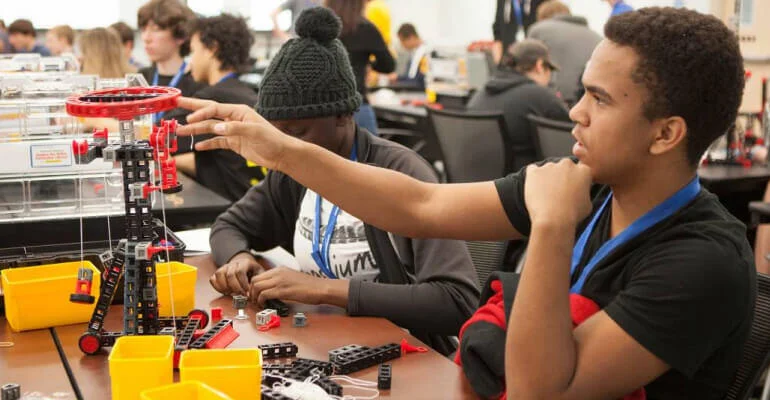
In an engineering pathway, advanced math is essential. But the way it’s taught—memorizing formulas and applying them to made-up scenarios—disconnects students from the real world. Let’s change that.
- Want to teach derivatives? Have students measure how the temperature of an electrical component changes as voltage increases—and grade them on the accuracy of their calculations.
- Want to teach the Pythagorean theorem? Put away the packets and get out the wood. Have students build actual right-angle supports that require precision and problem solving.
Every concept taught should be tied to a scenario a student might face in the field—or be a foundational building block for something they will use. If it doesn’t do one of those two things, we need to ask why it’s being taught at all.
Conclusion: Purpose Creates Motivation
Students today aren’t just struggling with academics—they’re struggling to understand why any of it matters. But by designing a system that starts with their future and builds backward, we can create education that’s clear, relevant, and motivating.
The hardest topics—and the final career destination—should dictate what gets taught and how it gets taught. That way, by the time students graduate, they’ll already have hands-on experience doing the kind of work they want to do. In today’s system, that kind of experience might take years to acquire. In a purpose-driven system, it’s part of the journey from day one.